Full-Day Excursion: Nova Gorica and Its Borderland Region of Transitions

Do you know where a state border runs across a shared square, where the border cut across graves for almost thirty years, and where the last French king is buried? Do you know which town was built on the site of another town’s former cemetery, and why Nova Gorica is considered one of the most unusual new towns in Europe?

The journey takes us to the Goriška region — a landscape of crossings and encounters, where the Romance, Slavic and Germanic worlds meet alongside Alpine, Dinaric and Mediterranean landscapes, as well as three distinct wine-growing regions.

Over the last century, this region has deeply felt the consequences of geopolitical change, when a newly established state border divided what had been a unified territory for centuries. Nova Gorica itself was created as a direct consequence of this division.

The excursion combines urban-historical exploration, landscape interpretation and stories of life along the border. The programme is modular and adaptable to each group, its interests and available time, meaning that every tour is slightly different.

The route usually begins at Cerje, offering one of the most impressive panoramic views of the entire region — from the Alps to the Adriatic Sea. We then descend to Miren, where we visit the cemetery that remained divided between Italy and Yugoslavia for almost thirty years after the Second World War.

This is followed by arrival in Nova Gorica, a town created as a political and urban project of socialist Yugoslavia, envisioned as a socialist showcase facing the West.

The walk through the town is not a conventional tourist tour, but rather a journey through the ideas, ambitions and contradictions of a new town. Along the way we explore modernist architecture, stories of the Cold War, smuggling, gambling, urban utopias and everyday life along the border. Step by step, we discover how the town’s original vision constantly evolved and why Nova Gorica looks the way it does today.

Lunch can be arranged in one of the nearby traditional osmicas, at a local tourist farm or in a more urban setting within the town itself. Alternatively, the lunch break can be shortened to allow more time for additional visits.

The programme may continue with a visit to the Franciscan Monastery Kostanjevica, where Charles X, the last French Bourbon king, is buried; with a guided visit to the City on the Border exhibition at the EPIC centre, dedicated to the history of the border and the divided Goriška region; or with a walk through the exotic Rafut Park surrounding Villa Laščak, one of the most unusual villas in Slovenia, built in a neo-Islamic style.

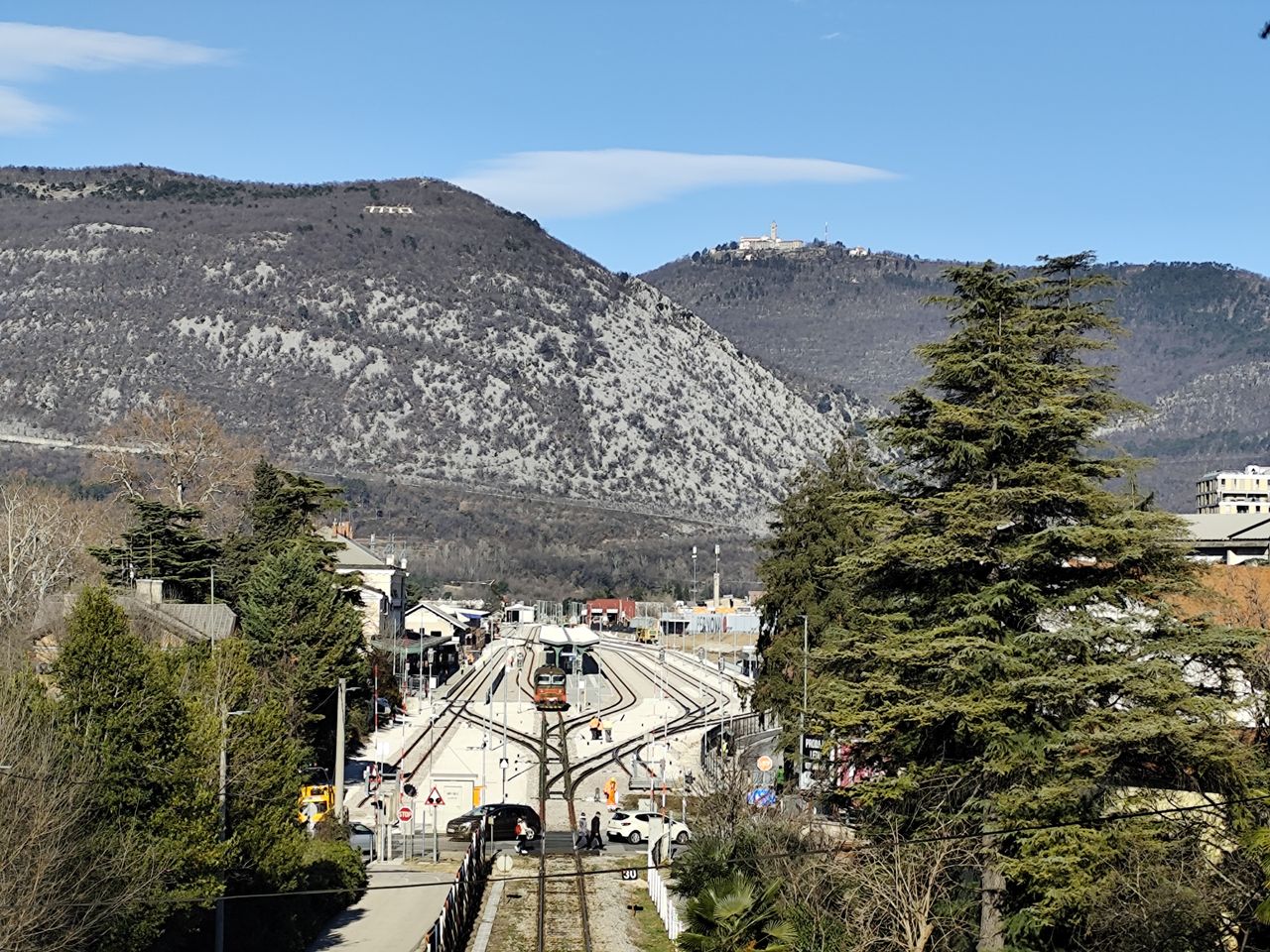
The excursion most often concludes at Europe Square in front of the railway station, where the border still runs across a shared public space and where Nova Gorica and Gorizia became the first cross-border European Capital of Culture in 2025.

The tour is led by Dr. Blaž P. Kosovel, researcher, cultural worker and author of the guidebook Nova Gorica – A New Town on the Border and the Digital Archive of Nova Gorica, which you are currently browsing.

Duration: full-day excursion
Walking: mostly flat terrain
Programme: adaptable to the group and its interests
Price for guiding and organisation: from 300 EUR onwards (depending on group size and special requests)

Prices of Additional Visits

  • Franciscan Monastery Kostanjevica – visit to the tomb of Charles X and the monastery library
    5–6 € per person
    Kostanjevica Monastery
  • EPIC – City on the Border
    8–11 € per person (depending on programme and guiding)
    EPIC – City on the Border