


Potok koren - vrtovi
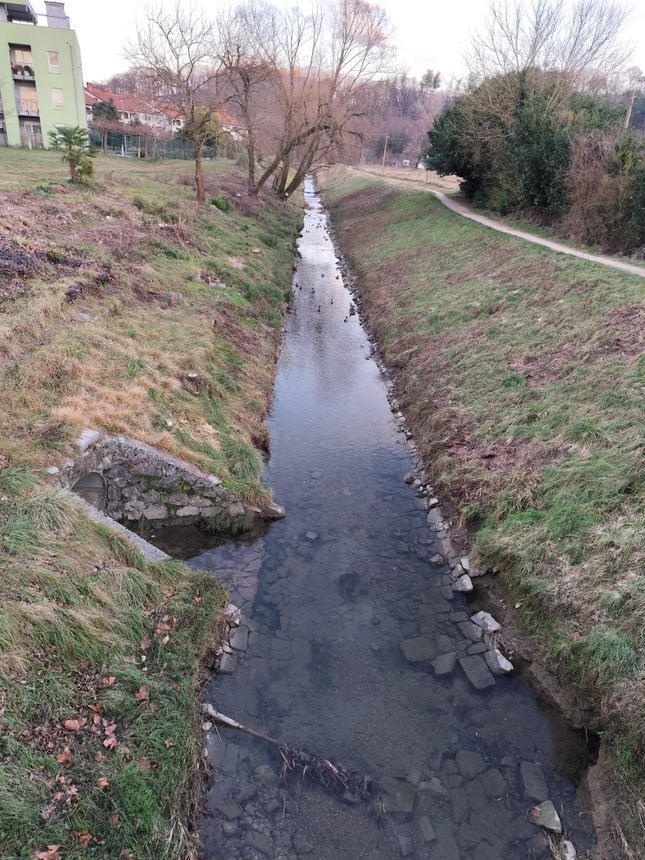
Nova Gorica began to develop on the former marshland along the Koren stream (dialect: Korn). The marsh was first drained by deepening the stream, “because before it was just a small creek,” as the first residents told us. “Then they began building the first blocks” (TZ, November 2022). Due to the slow pace of construction and development, in the 1950s and 1960s Nova Gorica was little more than a somewhat larger village, and there were hardly any major differences between life in the town and in the countryside, except for living in an apartment. The first residents came from the surrounding rural areas; they were accustomed to working in the fields and therefore greatly missed contact with the soil and the cultivation of their own produce. Over time, the authorities arranged gardens along the Koren stream, where people grew radicchio, lettuce, tomatoes, peppers, cabbage, and other garden crops. Some residents carried vegetables from the garden home in “borele” or on a moped. At the beginning people also bathed in the stream, as it was clean.
Many residents of Nova Gorica socialised in these gardens, including those who had moved to the town from more distant places. One of our interlocutors, who moved to Nova Gorica in 1972 and had her own garden along the stream, told us:
“I had a garden there along the Korn; now they have destroyed them and we had to move out. But there it was Yugoslavia in miniature. I have to say that. There we exchanged recipes. There was an enthusiastic young man who liked cooking and also gardening. Twice we all gathered together, all of us who had gardens there. Everyone had to bring something from the garden, something prepared from what they had grown. And we made a picnic. How beautiful it was. Macedonians, Bosnians, Serbs, even one Italian. Three people came from old Gorizia and brought seeds of pomidorov [tomatoes]. We exchanged them and gave them some as well. Someone still keeps that connection alive. At that time self-sufficiency was becoming fashionable. I don’t know if anyone would respond if we organised something like that today. And it wasn’t that long ago. Maybe eight or nine years ago we were still doing this. It happened every summer. It wasn’t self-sufficiency in the classical sense of the word; most of us were pensioners there, although there were also young people. For us who are retired it is also a way of life, socialising… There are playgrounds for children, sports fields and everything else; for us, the community gardens are like a playground. They gave the land to the housing fund and we had to clear everything. Along the Korn there was water and animals… Urbanisation destroys and undermines self-initiated actions… We are not aware of what a seed really means…” (The interview with the interlocutor, born in 1952, was recorded in October 2022).
The first gardens began to be removed already in 1974, when the present student dormitory was built along the Korn. The remaining ones disappeared during the revitalisation of the stream and the surrounding landscape, which began around 2015. Today, on the site where most of the gardens once stood, there is a football training field used by the local football club.
Avtor: Jasna Fakin Bajec
Vir:
- Ethnographic workshop with members of the Goričanke Association, October 2022
- Ethnographic workshop with elderly residents of the Nova Gorica Retirement Home, November 2022

Tags
Povezani članki
Koren Stream