


Furst’s Apartment Blocks by the Koren Stream
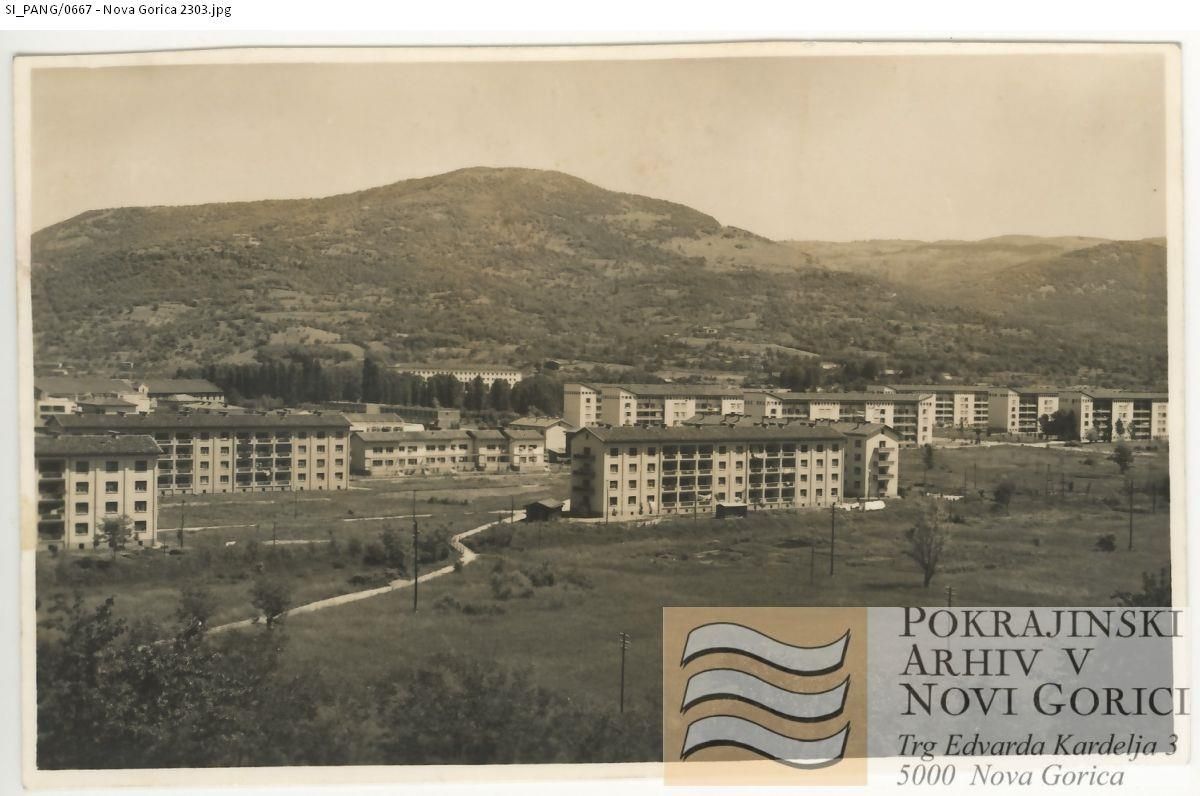
Between 1949 and 1952, blocks no. 14, 15, 16, and 17 were built along the Koren stream (today Trubar Street 9 and 11, and Rutar Street 3 and 4). They were considered workers’ housing for the Meblo Furniture Factory, and their distinctive feature was their unusual basements. Why?
Alongside Edvard Ravnikar (1907–1993), who prepared the first urban plan for the new city and designed its first residential blocks (the so-called “Russian blocks”), it is also important to highlight the work of architect Danilo Fürst (1912–2005), known as the designer of the B21 rapid-construction housing blocks, which were also part of the initial urban plan.
Fürst was highly critical of post-war housing construction, which was characterised by rapid, large-scale planning of apartment blocks based on standardised designs, placed in still undeveloped surroundings and very modestly equipped. In his view, the anonymity of designers, the lack of connection between design and final execution, and the influence of expert committees—who arbitrarily modified initial plans during construction—further contributed to the poor quality of housing.
It therefore became necessary to develop new housing plans that would reflect progress and incorporate practical experience (Fürst 1951: 6–10; cf. Di Battista 2017). Fürst began designing housing using a rapid-construction system, which, through the use of prefabricated elements (produced in controlled factory conditions rather than on exposed construction sites) and the abandonment of load-bearing exterior walls, marked a transition from traditional to semi-prefabricated and more economical building methods.
The blocks were built for workers of the Edvard Kardelj Furniture Factory (later renamed Meblo) and were located along the Koren stream. The architectural plans followed the B21 rapid-construction model but were slightly adapted (higher floor height; staircases cast on site rather than prefabricated; double windows with shutters).
These adjustments were due to local climatic conditions (different from those in Ljubljana, where the Kidričevo housing settlement was built according to the same model), as well as shortages of labour and building materials. Although Ravnikar’s urban plan initially foresaw fourteen blocks, only four were built between 1949 and 1952: blocks no. 14, 15, 16, and 17 (today Trubar Street 11, Rutar Street 4 and 3, and Trubar Street 9) (Di Battista 2021: 38).
Compared to Ravnikar’s blocks, Fürst’s were four-storey buildings, with smaller apartments better suited to working-class families. Almost all rooms were smaller, with the greatest differences in the size of the hallway, living room, and balcony. Some apartments even had two balconies, which were also placed on the shorter sides of the buildings (Di Battista 2021: 41).
In the book Nova Gorica: Her and My Youth (2008), local resident Nadja Koglot Puppis describes life in apartment no. 15:
“We moved into a new apartment where the walls were painted white, and in the living room there were faint semi-circles with floral patterns made using stencils. A very pleasant motif, lit by sunlight that found its way across Kostanjevica and through the balcony doors. In the kitchen there was a wood-burning stove; in the bathroom a bathtub and a standing stove, also wood-fired.”
(Koglot Puppis 2008: 17)
A distinctive feature of these buildings was the basement, which contained a communal laundry room with a large boiler and an even larger stone basin with a washboard and cold water.
“When I think of that laundry room, modern for its time, I am convinced that the greatest invention of the last century is the washing machine,” the author writes. According to interviewees, residents only acquired washing machines in the 1960s. Another interviewee described the laundry:
“The boilers were down in the basement. You lit a fire underneath to heat the water. Then you made lye—there were no detergents. And with a big ladle, you stirred it. Everyone did their own washing, cooked their own laundry. Outside there were posts—concrete or wooden—with wires, and that’s where the clothes were hung.”
(ethnographic workshop, October 2022)
Koglot Puppis also writes:
“The exterior of the building had not yet been plastered, so it was covered in rough concrete, which was dominated by children—from those who could barely walk to the slightly older ones. We mastered jumping between floors, visiting the third floor through the window, hiding across the roof to the other side of the block, and playing chase across all three levels. […] Next to the building there were two large lime pits filled to the brim with water. We had to figure out how to cross them on a raft, and the first one who tried crashed in the middle and came out soaking wet and completely white from head to toe. At home they washed and soaked him for hours.”
(2008: 17–19)
According to testimonies, workers from the furniture factory lived in block no. 17; workers from various companies lived in block no. 14; block no. 16 was shared between SGP and Meblo workers; and block no. 15 housed officials. Later, various companies claimed ownership of the apartments, which caused problems for residents. One interviewee who lived in block no. 14 recalled:
“When my husband went to work on a ship, we received an order to move out. I appealed, and we did not have to leave. I was lucky. I obtained the necessary documents from the archive for the construction of new settlements in Ljubljana and submitted them to the court. Other residents also had problems with apartment ownership. […] There were eleven of us living in the apartment: my husband’s parents in one room, a subtenant with children in another, and the six of us in the third. We lived like that for fifteen years. Later, the parents got their own apartment. There was no time for leisure—while the children were in school I stayed at home, and only later did I start working at Meblo.”
(Source: https://www.kamra.si/digitalne-zbirke/pavla-kante/)
Avtor: Jasna Fakin Bajec
Vir:
- Di Battista, Alenka. 2021. Ravnikarjevi bloki v Novi Gorici. Ljubljana: Založba ZRC.
- Alenka Di Battista. 2017. Urbanizem in arhitektura Nove Gorice skozi oči slovenske strokovne publicistike, GORIŠKI LETNIK – Zbornik Goriškega muzeja, št. 41, str. 43-69.
- Koglot Puppis, Nadja. 2008. Nova Gorica: njena in moja mladost. Ljubljana: Trip.
- Pavla Kante. Vir: https://www.kamra.si/digitalne-zbirke/pavla-kante/ (ogled: 5. 11. 2024).

Tags
