


Construction of the Solkan–Šempeter Road – the first action of the youth labour brigades
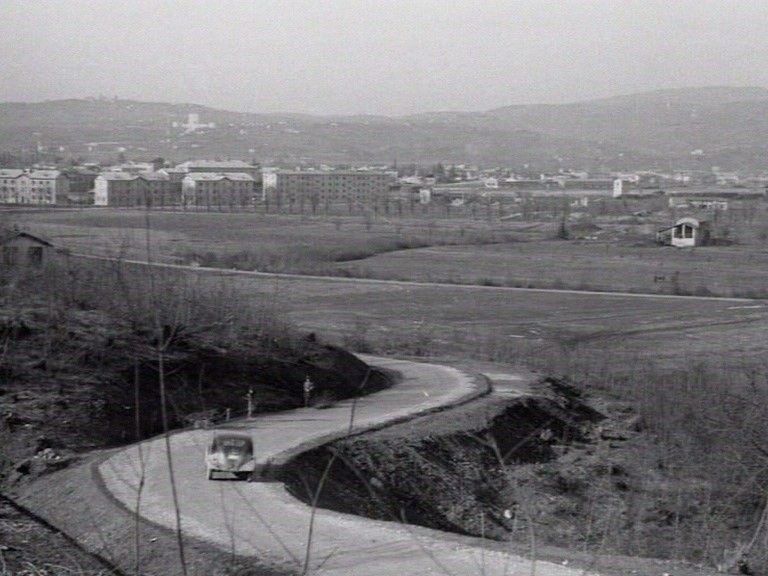
The construction of the Solkan–Šempeter road via Kostanjevica and Rafut was considered the first action of the youth labour brigades, which arrived in Gorizia in the first shift (3 December 1947 – 9 February 1948).
The new state border, which split the Gorizia region between two countries and cut its centre off from its hinterland, not only caused great hardship for the local population but also physically prevented passage from Solkan and Kromberk to Rožna Dolina and Šempeter pri Gorici.
“If today one wishes to travel by cart or other means from Solkan to Šempeter, which are about 5 km apart as the crow flies, one must return to the Vipava Valley, passing through Kromberk and Volčja Draga to bypass the hills. This route is 25 km long. Rafut cannot be reached by cart or car at all. Rožna Dolina, located in a narrow valley, is connected only to the Vipava Valley, but not to its neighbours Št. Peter [Šempeter] and Solkan.”
(Slovenski poročevalec, 6 Nov 1947, no. 261; cf. Marušič 2017: 133).
The path that once connected these places remained in Italy. For this reason, the first youth labour brigades, which arrived in Gorizia on 3 December 1947, immediately began constructing an alternative Solkan–Šempeter route. Construction works were initiated by the LRS Road Construction Company and led by engineer Ciril Pogačnik (1902–1973), who had previously built Tržaška Road in Ljubljana (Ukmar 1993: 25).
For the newspaper Slovenski poročevalec, he stated:
“I responded without hesitation when I was told that Nova Gorica was calling me. We arrived here with comrades immediately after annexation, and today we are rapidly organising everything needed to begin building the new road as soon as possible, at least from the day the final plans are approved.”
(6 Nov 1947, no. 261; cf. Marušič 2017: 134).
The youth brigades of the first shift worked for two months in extremely difficult conditions, in mud and bad weather, yet with great dedication and full enthusiasm, reportedly exceeding work norms by 60%. In addition to poor tools and a shortage of labour, one of the major challenges was the difference in elevation between locations.
“The altitude differences we will have to overcome are considerable: Šempeter lies at 80 metres above sea level, Markov Hill reaches 153 metres, Rožna Dolina again only 84 metres, while Kostanjevica stands at 165 metres.”
(Slovenski poročevalec, 6 Nov 1947, no. 261; cf. Marušič 2017: 135).
Preparatory works also included the construction of an auxiliary, or bypass, road intended to enable quick passage between Solkan and Šempeter and to support the builders of the permanent road. The residents of Rafut also contributed through voluntary work, arranging side paths and cart tracks across Kostanjevica. Trucks and farmers with ox-drawn carts transported gravel, which was laid by rollers onto the soft clay surrounding the marshy terrain.
The temporary circular road was completed during the first shift, which ended on 9 February 1948, and was made suitable for regular traffic between the two centres (Ljudska pravica, 1 Feb 1948, no. 27; cf. Marušič 2017: 149).
Avtor: Jasna Fakin Bajec
Vir:
- Oskar Jogan, Nova Gorica: Zgradili smo mesto, https://www.kamra.si/digitalne-zbirke/oskar-jogan/ (ogled: 27. 10. 2024).
- Priprave za gradnjo ceste Solkan-Šempeter – glavne prometne žile bodoče Nove Gorice. Članek je bil objavljen v dnevniku Slovenski poročevalec, 6.11. 1947, št. 261. Članek tudi zasledimo v knjigi: Marušič, Branko (ur.). 2017. Narodu Gorico novo bomo dali v dar: Ob sedemdesetletnici Nove Gorice. Nova Gorica: Območno združenje Zveze borcev za vrednote narodnoosvobodilnega boja, str. 132-135.
- Ukmar, Dragica. 1993. Začetki gradnje Nove Gorice, Kronika: časopis za slovensko krajevno zgodovino (1993), letnik 41, številka 2. URN:NBN:SI:doc-T6USNG8G, http://www.dlib.si, str. 18-37.

Tags
Povezani članki
How and why the planning of Nova Gorica began Youth Work Brigades in Nova Gorica Začetki gradnje Nove GoriceZgodbe
