


Church of Christ the Redeemer - in detail
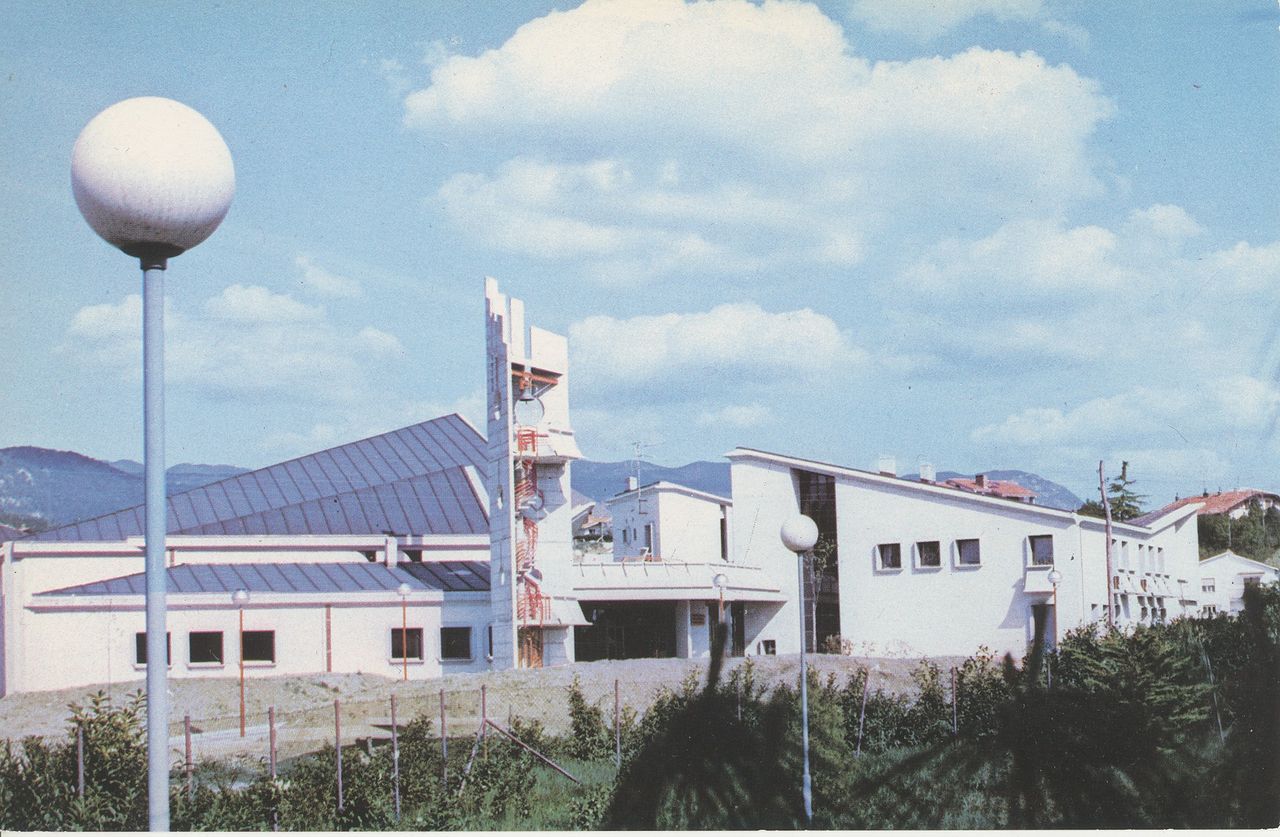
©From the collection of Regional Archive in Nova Gorica - PANG 667 Zbirke razglednic krajev Nova Gorica
1 / 4
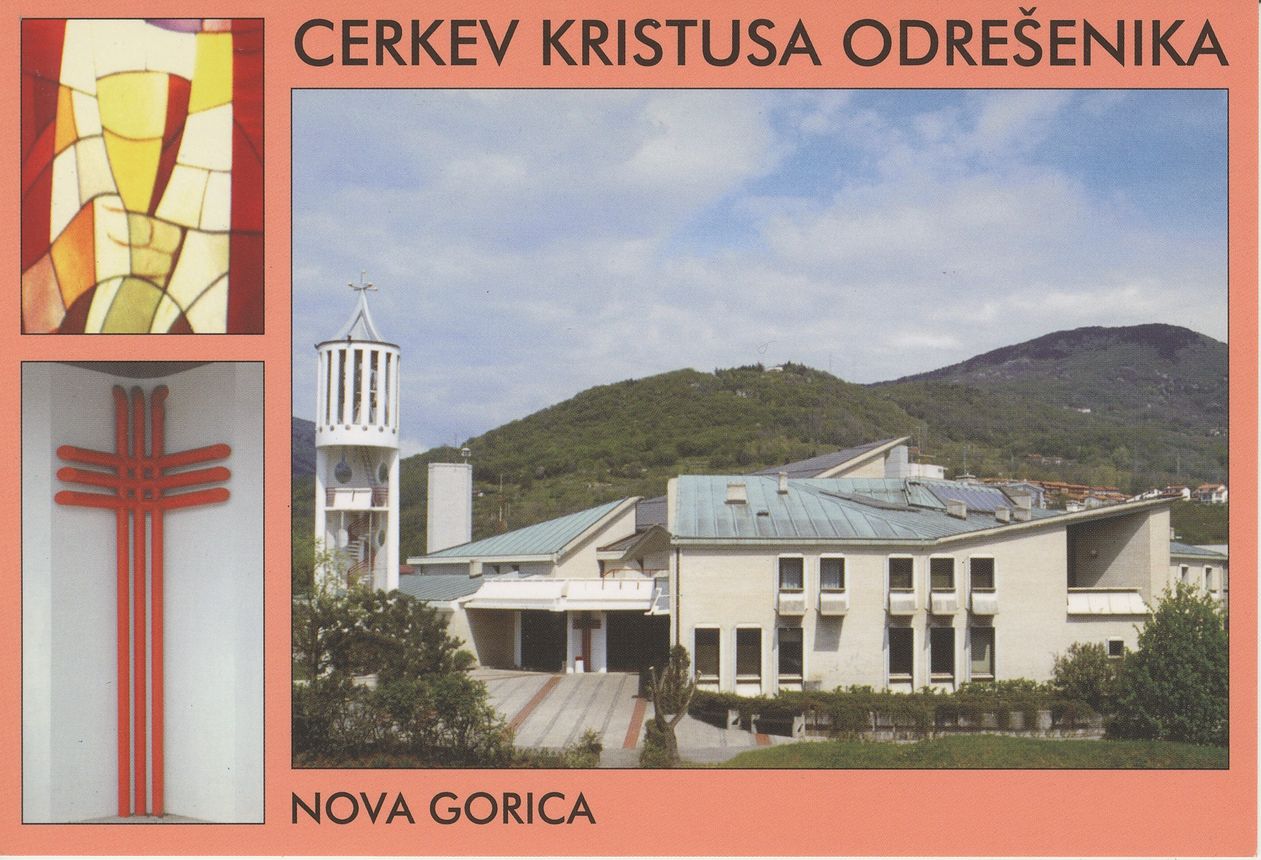
©From the collection of Regional Archive in Nova Gorica - PANG 667 Zbirke razglednic krajev Nova Gorica
2 / 4
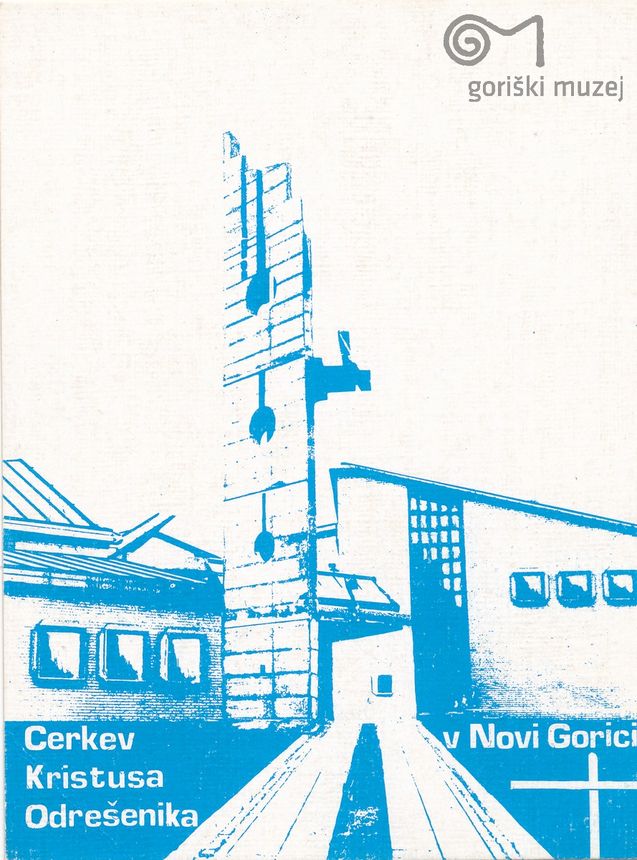
©Photo Pavšič, from the collection of the Goriški muzej Kromberk - Nova Gorica (Goriška museum).
3 / 4
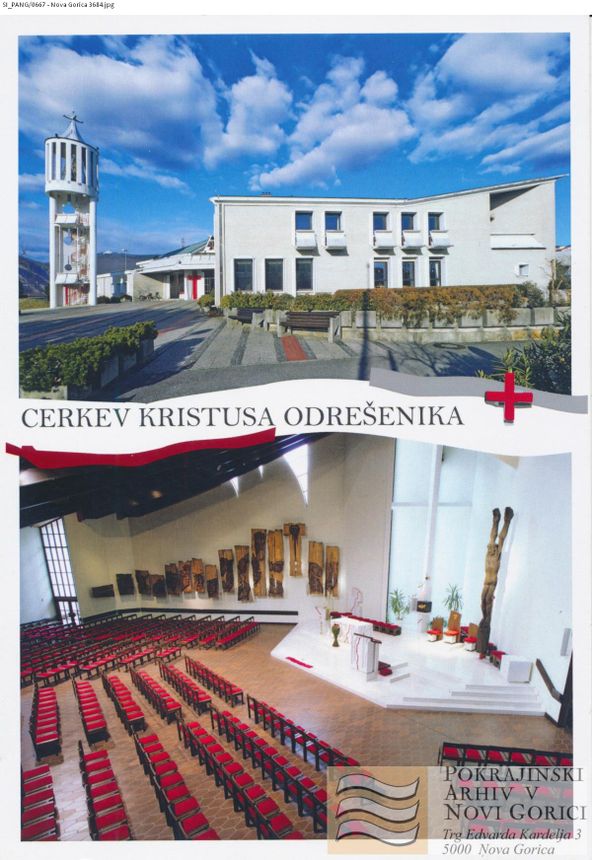
©From the collection of Regional Archive in Nova Gorica - PANG 667 Zbirke razglednic krajev Nova Gorica
4 / 4
The original urban plan of Nova Gorica did not include a religious building at its core. For this reason, in 1966, Dore Klemenčič described Nova Gorica as a “town without a bell tower.” Christians nevertheless gained their own centre in the city in 1982.
Nova Gorica was built during the socialist period, when the authorities maintained full control over Roman Catholic activity until the 1970s, viewing the Church as one of their main ideological opponents and a strong opposition force (Repe 1997: 121). As a result, efforts were made to weaken its influence or even exclude it entirely from the cultural and spiritual sphere. The situation gradually eased after 1966, when an agreement between the Vatican and Yugoslavia was re-established (ibid.: 122).
These circumstances are closely tied to the efforts to build a Roman Catholic church in Nova Gorica, as residents had already expressed a desire for a spiritual centre as early as 1959. Until then, locals attended services at the Franciscan monastery at Kapela and in the parish churches of Solkan and Kromberk. The first formal request to build a new church and parish house was submitted by the dean of Solkan, Andrej Simčič, a representative of the apostolic administrator Dr Mihael Toroš, but without success. In 1976, however, residents managed to purchase a building at 40 Partizanska Street, where temporary facilities were arranged; on 3 June 1976, the Parish of Christ the Saviour was established and began operating on 1 September of the same year (Martelanc 2016: 26).
The construction of the Church of Christ the Saviour and its art-historical characteristics were studied in detail by art historian Tanja Martelanc. In her article “In a Town Without Bell Towers…” (2016), published in Izvestje 13, she highlights several key findings.
The plans for the new church were prepared by architect Franc Kvaternik (1933–2018). As the Second Vatican Council (1962–1965) was already in effect—advocating that a church should be “a house among houses”—the Nova Gorica church was not conceived as a monumental structure dominating its surroundings, but rather as a building shaped by and integrated into its environment.
The new church was consecrated on 12 December 1982 by Bishop Dr Janez Jenko and dedicated to Christ the Saviour. The parish bears the same name and celebrates its feast on the Sunday of Christ the King. The complex is conceived as a “village of believers” within the newly built city. It is located along one of the main entry roads to Nova Gorica, Vojkova Street, and a linden tree has been symbolically planted in front of the church.
The entrance leads into a vestibule connecting the main units of the parish complex: the liturgical, educational, and residential areas. The church building stands on the northern side, oriented eastward; a side chapel lies to the south, while the sacristy and parish rooms are to the west. South of the church is an atrium, around which classrooms and other facilities are arranged, including a Montessori kindergarten.
The upper floor contains the living quarters of the parish priest and other staff. Beneath the church is a shelter, also used as a social space, while additional rooms for various activities are located beneath the other wings.
Dominating the presbytery is a monumental wooden sculpture of the Crucified Christ (540 cm), created in 1982 by academic sculptor Stane Jarm (1931–2011). The rough carving—Jarm worked with a chainsaw—and the deliberately disproportionate shaping of the body are characteristic of his artistic expression. However, the Nova Gorica Crucified is no longer distant in divine transcendence; he has descended to earth and come closer to the ordinary person. Jarm himself emphasised that he saw in Christ above all the incarnate human being, seeking not divine perfection but the expression of ultimate human suffering and surrender. With arms raised rather than outstretched, the figure reinforces the verticality of the architecture and creates the impression of upward movement, symbolising redemption.
Another notable feature is the wooden Stations of the Cross, also by Jarm, installed on the eastern wall of the liturgical space. It is conceived as a unified artistic work with a clear dramaturgical structure—development, climax, and resolution. Jarm transformed 15-centimetre-thick oak boards into fourteen stations, adding an additional preliminary scene; each station consists of two wooden elements shaped with a chainsaw.
The side chapel dedicated to the Virgin Mary is intended for a more intimate encounter with worshippers and can be easily connected to the main space through glazed rotating doors. It contains a raised wooden altar with an ambo and a sculpture of the Virgin Mary—an atypical work within Jarm’s oeuvre.
During Easter 2001, the bell tower—also designed by Kvaternik—was completed, housing four bells. On 25 November 2001, a statue of Frančišek Borgia Sedej (1854–1931) was blessed and installed nearby. Sedej became Archbishop of Gorizia and Gradisca on 21 February 1906 and held the position until 25 October 1931, when he was forced to retire under pressure from the Italian authorities due to his opposition to Italianisation.
On 15 March 2004, the church was elevated to the status of co-cathedral, granting it the same rights as the main cathedral of the diocese. On 16 January 2014, the parish was renamed the Parish of Nova Gorica. Today, the parish centre represents the main ecclesiastical hub of the Gorizia region (Martelanc 2016: 26–33).
Avtor: Jasna Fakin Bajec
Vir:
Martelanc, Tanja. 2016. V mestu brez zvonikov … Nekaj paberkov o novogoriškem župnijskem središču. Izvestje 13, str. 26 – 33.
Repe, Božo. 1997. Škofovska izjava o lojalnosti in pastirsko pismo: V: Slovenska kronika XX. Stoletja, 2. izd. Ljubljana: Nova revija, 121 – 122.

Tags
Povezani članki
Church of Christ the Redeemer