


Blanče – the site of the new town
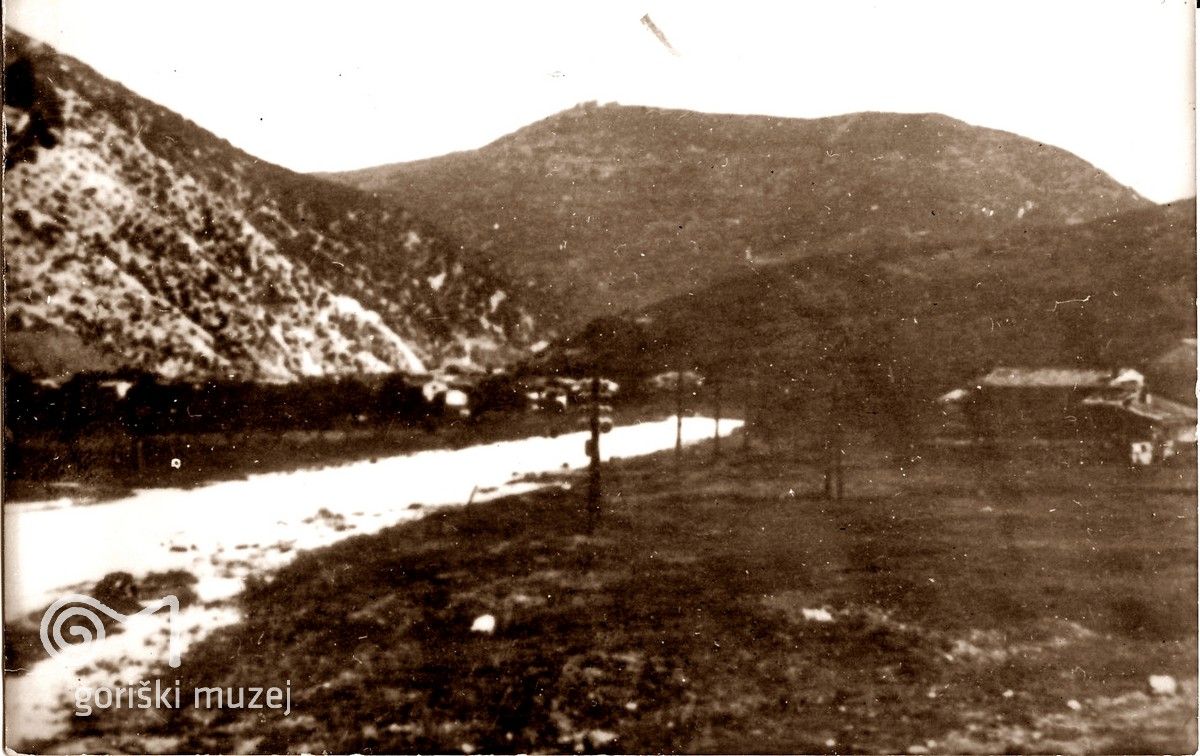
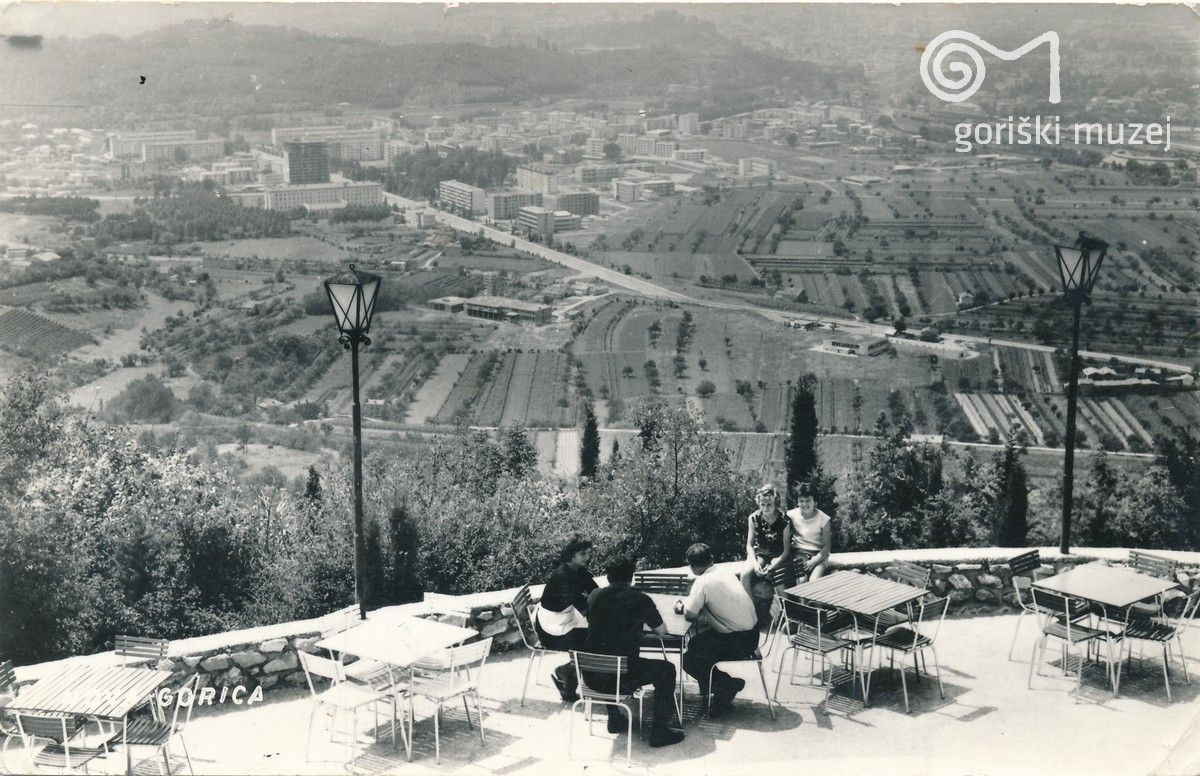
Nova Gorica began to take shape in the area of Blanče, on the southern edge of the Solkan field.
At a meeting of the Department for Construction and Reconstruction within the economic section of the District Executive Committee of Gorizia on 17 April 1947, a working committee for the construction of the new town was established. Its first task was to swiftly examine and select a site for the future centre of the Gorizia region. Three possible locations were considered: Rožna Dolina, the immediate vicinity of Šempeter, and the Solkan field, specifically the area known at the time as Blanče, situated on the southern edge of the field between the railway station and Grčna.
Rožna Dolina was deemed the least suitable option due to spatial constraints that would hinder the city’s future development, and this proposal was quickly dismissed. The decision thus narrowed to a choice between the Solkan and Šempeter fields. The prevailing opinion favoured the Solkan field, owing to its advantageous transport position at the junction of the Soča and Vipava valleys and its lower agricultural value compared to the highly cultivated Šempeter field. In addition, the selected location had another important advantage: its immediate proximity to Gorizia would allow for the eventual unification of the two towns—the old and the new Gorizia.
As noted by Petra Kolenc in her study on the Ursulines in the Gorizia region and their estates in Blanče (2022), the field name Blanče referred to an area on the Gorizia plain between Frnaža and the railway station, bounded on the left by the Koren stream and gradually merging into the Solkan field on the right. The Slavic origin of the place name Blanca is linked to Czech words meaning meadow or pasture, while in Belarusian it denotes “empty land in front of a village,” and in Russian “a flood-prone meadow by a river” (Snoj 2009: 64; cf. Kolenc 2022: 34). Researcher Vladimir Klemše proposes that the name derives from the muddy nature of the terrain (Blanča/Blatna). Architect Tomaž Vuga, in his book Projekt: Nova Gorica, drawing on historian Vojko Pavlin, suggests that the name is connected to “White Sunday” and the Church of the Holy Trinity in Solkan, from which the wider area may have taken the name Biancha or Ai Bianchi, later phonetically transformed into Blanče (2018: 36). The area was shaped by four key elements: the Koren stream, St. Gabriel Street (Pokopališka Street, today Erjavčeva Street), and the Frnaža brickyard.
Historian Metka Nusdorfer Vuksanović, in her article “When the Solkan Field Was Still Ploughed” (2002), highlights the muddy character of the area where Nova Gorica later emerged, citing a 1921 article from Goriška straža. The correspondent expressed dismay at the soaked terrain between Gorizia and Kromberk, crossed at the time by Erjavec’s avenue (Via del Camposanto, today Erjavčeva Street): “And the roads! Are there worse roads anywhere in this world than the road from Gorizia to Kromberk, or from Solkan to Kromberk? In rainy weather, one could drown in the mud!” (16 March 1921, no. 11; cf. Nusdorfer Vuksanović 2022: 225).
Between 1903 and 1906, railway infrastructure began to develop in the Blanče area, significantly transforming parts of the landscape. Clay fields also remained, which until the 1920s were owned by the Ursuline convent in Gorizia (see Kolenc 2022). Most houses in the area were damaged during the First World War. In the 1920s and 1930s, owners rebuilt their homes on repurchased land. A farm typically consisted not only of the residential building but also of various outbuildings: a stable, pigsty, hayrack, annexes, sheds, and a courtyard with a garden. Around the houses there were usually orchards and vineyards (cf. Nusdorfer Vuksanović 2002: 240). On the wet meadow along the Koren stream there were also several isolated farms belonging to nearby Grčna, a hamlet under Kromberk.
Muddy streets persisted even during the construction of the town, until roads and the surroundings of apartment blocks were properly arranged. One interviewee (born in 1939) recalled everyday life in early Nova Gorica:
“It stayed in my memory like this. When the weather was bad, there were no roads, only mud. How to get to the building entrance? You know how we walked? With three bricks, moving them along. At that time most people had bicycles. If you had one, you carried it on your shoulder to the entrance. If you wanted to ride, you couldn’t get anywhere. It really stayed with me, that memory.” (TZ, November 2022)
Avtor: Jasna Fakin Bajec

Tags
