


Udine Agreement – introduction of border passes
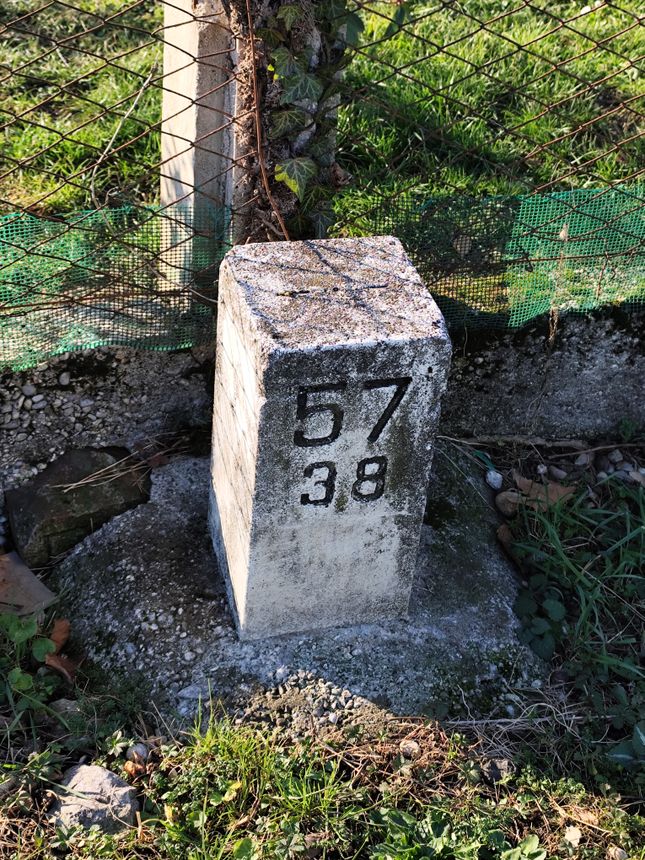
With the Udine Agreement of 1955, residents living within a 10-kilometre border zone were granted border passes for the first time—documents that allowed them to cross between Yugoslavia and Italy.
The new western border, established after the Paris Peace Treaty of 10 February 1947, deeply affected everyday life. It cut through farmland, houses and even cemeteries; according to local accounts, it sometimes ran straight through barns. One of the most striking cases was the division of the cemetery in Miren, where graves were literally split in two.
The situation was partially alleviated by two Udine Agreements (1949 and 1955). The first allowed landowners to cultivate fields across the border, while the second significantly expanded mobility rights. With the introduction of border passes, residents could cross at local border points—initially under strict limitations, later with increasing freedom.
Until 1955, the border had been tightly controlled, marked by fences, guard posts and military patrols. Many people emigrated to Italy, and numerous families were separated.
The 1955 agreement marked a turning point: dozens of local crossings were opened, around 250,000 passes were issued, and relations between communities on both sides of the border gradually normalised. The hostile post-war atmosphere began to ease, and the border slowly transformed from a rigid divide into a space of contact.
In the following years, crossing conditions were further liberalised (notably in 1962), and the border became a site of lively exchange. Italian goods—especially consumer products—flowed in one direction, while food and agricultural products moved in the other.
The border thus evolved from a symbol of separation into a space of everyday interaction, encounters and cooperation, reflected also in joint events such as the Friendship Walk and Cycling events.
Avtor: Jasna Fakin Bajec
Vir:
- Marušič, Branko (1998). Nova meja na Goriškem. Acta Histriae, letnik 6, številka 6, str. 271-284. URN:NBN:SI:DOC-27JFYF1P from http://www.dlib.si [ogled: 12. 10. 2024]
- Nećak, Dušan. 2000. Trst, mesto nakupov, Prispevki za novejšo zgodovino XL, ŠT. 1, str. 301-311.
- Šušmelj, Jože. 1997. Odpiranje meje: Sodelovanje med Novo Gorico in Gorico. V: Jan, Zoltan (ur.). Nova Gorica-Gorica: izzivi in možnosti sobivanja: zbornik. Nova Gorica: Mestna občina, str. 9-28.
- Svenšek, Ana. 2019. "Pot do priključitve Primorske so spremljali številni dramatični dogodki": intervju z Jožetom Šušmeljem. RTV SLO, 15. september 2019. https://www.rtvslo.si/slovenija/30-let/pogovori/pot-do-prikljucitve-primorske-so-spremljali-stevilni-dramaticni-dogodki/499583 (ogled 27. 10. 2024).
