


The beginnings of the construction of Nova Gorica
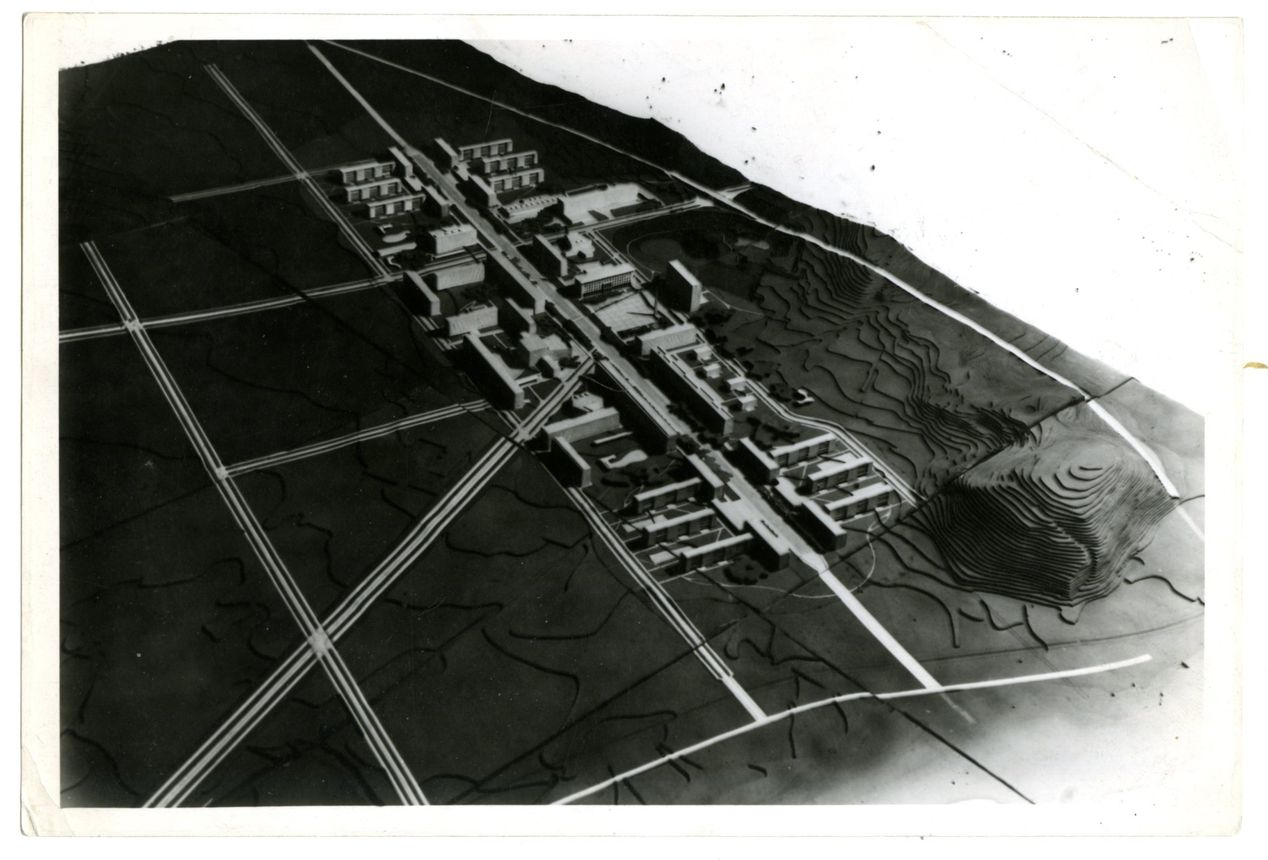
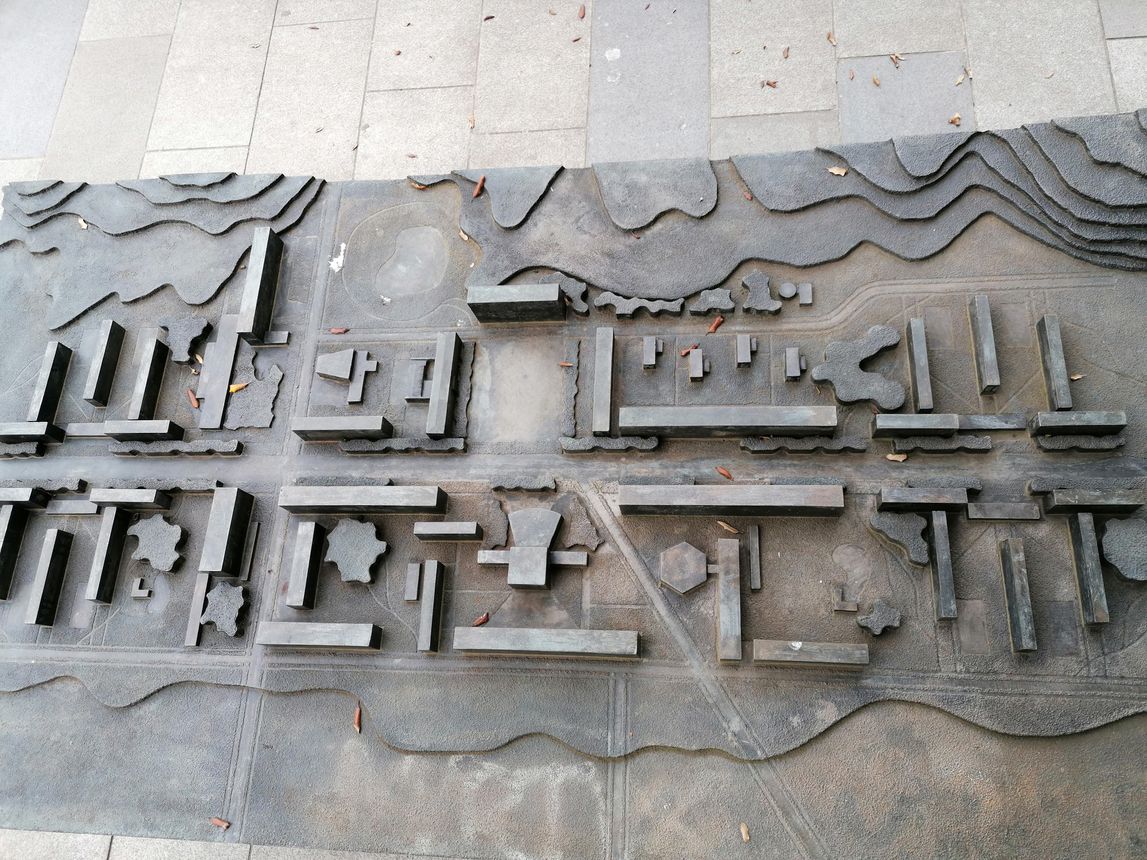
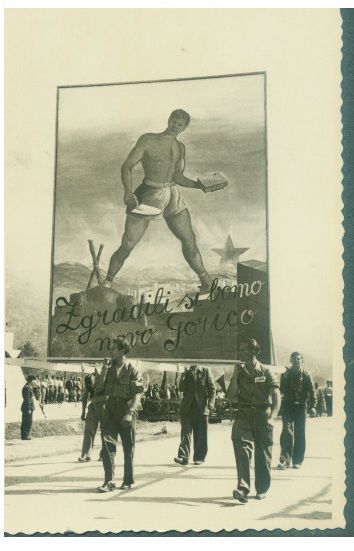
The early stages of building the new town raised a series of questions for the Ministry of Construction, the local people’s authorities, the construction committee, and the first architects alike. What challenges did they face?
The day after the signing of the Paris Peace Treaty, on 11 February 1947, a new governing body was established in Ajdovščina — the District Executive People’s Committee (OILO) Gorizia (later District People’s Committee – OLO Gorizia). Its president became Bogomil Vižintin (1905–1978), an activist of the Liberation Front and a member of the secret organisation TIGR, who spoke of creating a new centre of the Gorizia district right next to Gorizia in Italy. Preparations for the construction of a new town began at that moment, initiated largely by the district leadership itself.
It remains unclear when the idea of building a new town first appeared at the local, republican, or federal level. There was considerable uncertainty and waiting, as the final state border had yet to be determined and the peace treaty fully implemented (Marušič 2020: 7). The first concrete step was taken on 17 April 1947, when a special working committee was established to prepare the construction.
“With the unjust border, which temporarily separates us from the major cultural, commercial and transport centre of Gorizia, it is foreseen that a new settlement will have to arise in its immediate vicinity, for geographical, economic and infrastructural reasons” (District People’s Committee Gorizia, 17 April 1947; cf. Nusdorfer Vuksanović 2002: 220).
Older residents recall that the loss of Gorizia brought deep poverty, and that the promise of a new centre brought hope and momentum:
“We will build you a town you will be proud of. Because we lost Gorizia — for us on this side of the border, it was a huge loss. The partisans liberated Gorizia and Trieste, yet we got neither. It was terrible. And on top of that, they took more land with those agreements. The Rapallo border had already taken a lot from us, and afterwards it was hard to make up for it. /…/ When the border came down, it was over. Poverty set in here. There was no coffee, no clothes. Before, you could buy things in Gorizia. So poverty took hold. We reused old clothes and sewed them ourselves” (Ethnographic workshop with Nova Gorica pensioners, November 2024).
The first meeting of the committee took place on 24 April 1947 in Ajdovščina. They discussed a draft plan prepared by engineer Božidar Gvardijančič (1909–1972), who proposed locating the new town near Šempeter pri Gorici. During the discussion, however, Dr. Franc Marušič argued that the new settlement should be built between Solkan and Gorizia, in the area of Blanče, close to the “old” town — also to help “our people more easily overcome the loss of Gorizia” (Marušič 2020: 22).
“Gorizia is the heart of our Primorska, a land of sun and eternal spring. And that Gorizia was taken from us. They stole it from us. They tore the heart out of the mother’s body. /…/ We have not renounced it and never will, even if today we are building a new town — Nova Gorica” (Tovariš, 28 May 1948; cf. Marušič ed. 2017: 156).
The question of location was ultimately decided by the Minister of Construction, Ivan Maček (1908–1993), who visited both proposed sites with a team of experts and supported the Solkan option, between Blanče and Grčna. The following day, three architects — Božidar Gvardijančič, Edvard Ravnikar, and Marko Župančič — were commissioned to prepare plans for the new town. Ravnikar’s proposal was selected.
The idea of a new town soon became reality. On 21 September 1947, during celebrations marking the annexation of the Littoral to Yugoslavia, the Slovenian Prime Minister Miha Marinko (1900–1983) announced the investment plan for the region (1947–1951), which allocated nearly one billion dinars to Nova Gorica alone. The plan envisioned housing for 10,000 residents, administrative buildings, schools, hospitals, post offices, a bank, courts, and customs facilities. A significant portion was also dedicated to building a hotel as part of the basic tourist infrastructure.
In October and November 1947, the first workers began preparatory works on the future construction site, followed by youth labour brigades. However, from the early 1950s onwards, political changes and financial shortages slowed down construction. The scope of works was reduced, and the project increasingly relied on local funding, while investments were redirected elsewhere in Yugoslavia, such as New Belgrade.
On 7 November 1949, the name Nova Gorica was officially mentioned for the first time as a settlement within the local community of Solkan. On 19 April 1952, the Municipality of Nova Gorica was formally established.
Avtor: Jasna Fakin Bajec
Vir:
- Marušič, Branko (ur.), Narodu Gorico novo bomo dali v dar: Ob sedemdesetiletnici Nove Gorice. Nova Gorica: Območno združenje Zveze borcev za vrednote narodnoosvobodilnega boja.
- Marušič, Branko. 2020. O Novi Gorici in o okoliščinah njenega nastajanja, Izvestje 17, str. 3–16.
- Nusdorfer Vuksanović, Metka, 2002. Ko so na solkanskem polju še orali: Kje je zrasla Nova Gorica. Trpin, Drago (ur.), Zbornik Pokrajinskega arhiva v Novi Gorici: ob 30. obletnici ustanovitve. Nova Gorica: Pokrajinski arhiv., str. 219–244.
- Ukmar, Danica. 1993. Začetki gradnje Nove Gorice, Kronika: časopis za slovensko krajevno zgodovino (1993), letnik 41, številka 2. URN:NBN:SI:doc-T6USNG8G from http://www.dlib.si, str. 1837.
- Ramšak, Jure 2017. Casino v socialističnem mestu. Annales. Series historia et sociologia, letnik 27, številka 2, str. 363-378. URN:NBN:SI:doc-2ODDG01X from http://www.dlib.si
