


“Hawaii” – the first school and gymnasium
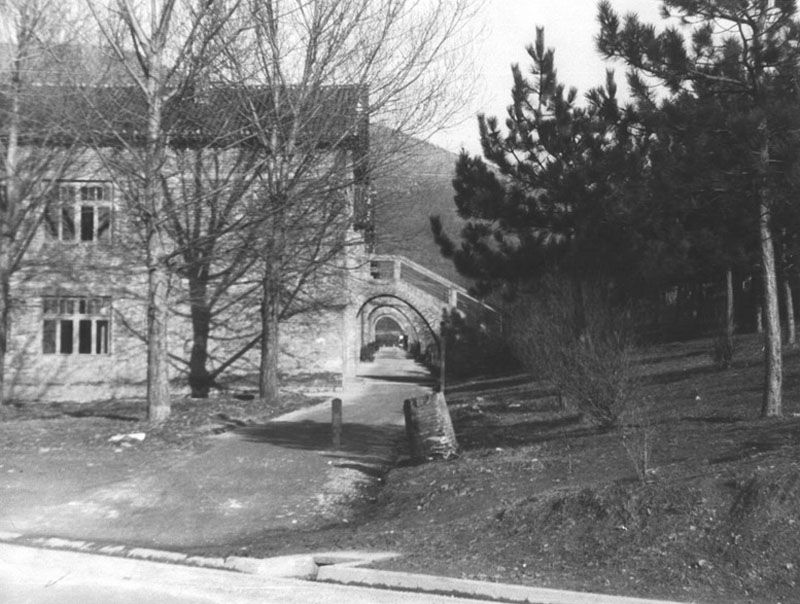
The first organised education in the new town:
The first school and gymnasium in Nova Gorica were established in 1951 in the area known as “Hawaii” (Mali klanec, Ronket hill), a part of the city where a workers’ settlement had been built in 1948. But why was the area called Hawaii?
Before the establishment of a school in Nova Gorica, children attended primary school in Solkan or Pristava. In 1951, classrooms, a cultural hall, and a gym were arranged in the former premises of the workers’ settlement on Mali klanec. These buildings had originally served as accommodation for workers arriving from distant regions.
Initially, a four-grade primary school and a four-grade lower gymnasium were opened. In 1961, the new Milojka Štrukelj Primary School was built, and the premises at Hawaii were converted into a student dormitory.
“Because there were lots of girls up there and everything… the boys said, now we’re going to Hawaii. You know: youth, conquering and all that.”
(interviewee, born 1951, interview conducted in November 2022)
Memories of the school at Hawaii remain fond among residents.
The first headmaster, Miroslav Nakrst, recalled:
“The eight-year primary school was established in 1958. Before that, pupils attended four-year primary schools and four years of lower gymnasium. In the early years, classes took place in the building of today’s student dormitory in Grčna. Teaching was organised in two shifts, and the conditions were poor. The buildings were unplastered and cold. In 1961 we moved into a new building, which, however, did not have a gym.”
On 19 June 1962, the school was named after Milojka Štrukelj. The left wing originally housed 24 classrooms and offices for the Nova Gorica primary school, while the right wing accommodated the Gorizia gymnasium (online source 1).
Former pupils remember:
“Children walked there along often muddy paths through a small pine forest. Later, a bus service was introduced. Classrooms were crowded and heated with wood-burning stoves. Some classrooms were supported by wooden pillars. A school caretaker walked between the buildings, ringing a large hand bell to mark the beginning and end of lessons. For snacks, food from American aid packages was sometimes distributed, though pupils usually brought modest meals from home. In 1951, this four-grade school had 111 pupils. In 1961, the new eight-year primary school with twenty-four classrooms opened for the first time; the right wing housed the Gorizia gymnasium. The premises vacated by the gymnasium were later taken over by the Workers’ University, while the student dormitory remained in Grčna. School facilities became permanent, and over time several secondary school dormitories were merged into one building.”
(Ideal, https://www.kamra.si/digitalne-zbirke/davorin-zupan/)
Architect Tomaž Vuga from Nova Gorica recalled his days at the lower gymnasium (today equivalent to the 6th grade):
“Our new gymnasium premises were in the northern building, the fourth of four, built of brick and left unplastered, with wooden ceilings. /…/ It resembled a wooden barrack more than a school. /…/ The two central buildings were intended for the gymnasium, while the southern one was converted into a student dormitory. In the former common areas of the workers’ home, a kitchen and dining hall were arranged for the dormitory, while a larger part was turned into a gym. It served multiple purposes—from student performances to dances. The surroundings were muddy and undeveloped.”
(Vuga 2018: 113)
“There was a large stove in the room to keep us warm, and there were about forty of us in a class. At the top of the hill there was a gym where the Partizan gymnastics society operated, led by Dušan Furlan. They were very active.”
(https://www.kamra.si/digitalne-zbirke/gorazd-humar/)
The gym was later converted into premises for the textile factory Ideal (https://www.kamra.si/digitalne-zbirke/davorin-zupan/).
The young city of Nova Gorica continued to grow and develop. With the increasing number of children, the need for a new school became urgent. In 1981, a new primary school named after the IX Corps was built—today’s Fran Erjavec Primary School.
Avtor: Jasna Fakin Bajec
Vir:
- Online source 1: OŠ Milojke Štrukelj Nova Gorica, Zgodovina šole, https://www.osms.si/vizitka/zgodovina-sole/
- Nova Gorica: Zgradili smo Novo Gorico. Digitalne zbirke.

Tags
