


Theatre: the Mark of the Theatre of the Absurd
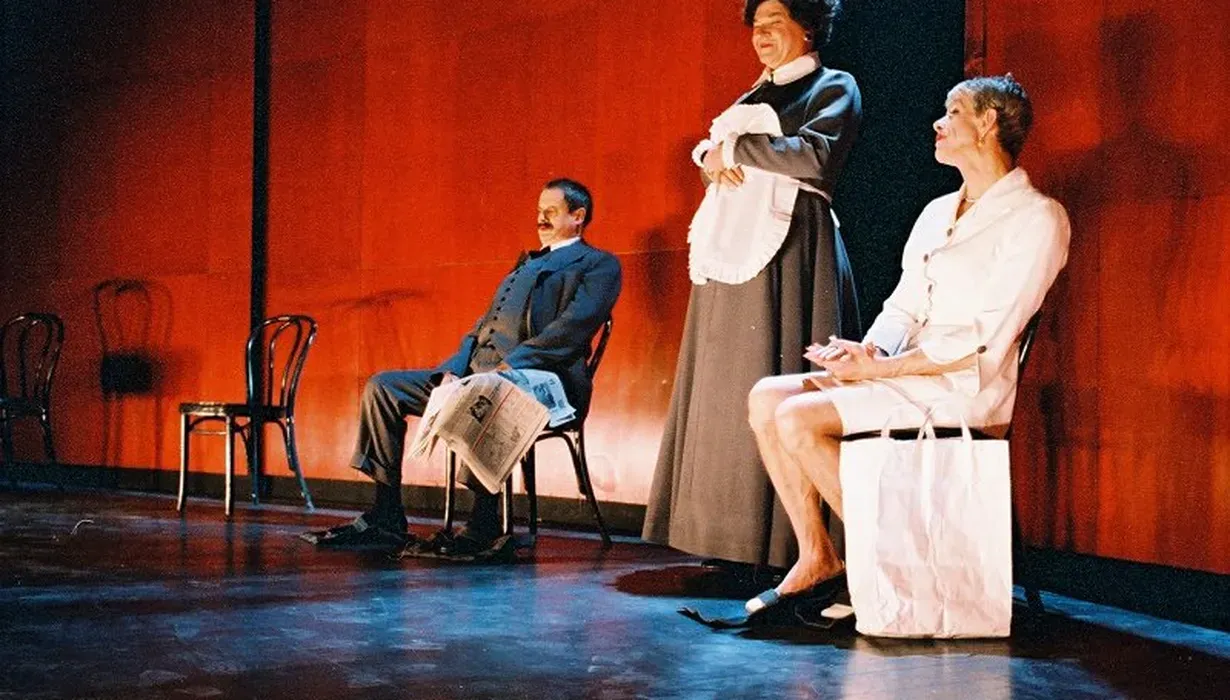
Among the dramatic currents that shaped the repertoire of the Nova Gorica theatre, the theatre of the absurd—defined by Martin Esslin in his influential early-1960s study—certainly holds a prominent place. A special position in the institution’s history is already occupied by Jean Genet’s Haute Surveillance (Deathwatch), which premiered in 1972 under the direction of Iztok Tory, marking both the inauguration of the Chamber Stage of the Primorsko Dramsko Theatre in the Nova Gorica courthouse building and the opening of the first edition of the Goriška Meeting of Small Stages festival. Despite certain critical reservations, the production represented a significant repertory achievement for the recently professionalised theatre; particular attention was drawn to actor Ivo Barišič, who would later master roles within the theatre of the absurd in the 1990s, when the Nova Gorica theatre became recognised in Slovenia for staging such works.
This chapter of the repertoire proved especially fruitful in the synergy between members of the acting ensemble and director Vito Taufer. It reached one of its peaks already at the very beginning, with the production of Eugène Ionesco’s The Bald Soprano, which premiered in 1995, continued to be performed for more than a decade, and exceeded 150 performances. Yet the story of this production—much like that of its dramatic source—is one of fortunate coincidences. If Ionesco had not wished to learn English, if he had not encountered in a French-English conversation manual a “series of astonishing truths,” if during rehearsals for the premiere one of the actors had not misspoken and said cantatrice chauve instead of institutrice blonde… And if there had not been a change in the repertoire of the Primorsko Dramsko Theatre, this chapter of the absurd might never have taken place.
All elements of staging contributed to the refinement of the Nova Gorica Bald Soprano, yet the leading role was undoubtedly played by the cast. The characteristics of the characters were defined not only through expressive facial expressions, gestures, and bodily movement, but also through stage props—such as the shopping bag with which Barišič, as Mrs Smith, was constantly occupied, yet without ever abandoning the poise of a refined hostess. Through thoughtful interpretations of male and female characters, the actors impressed both domestic and international audiences. During tours in South America, they received enthusiastic applause, demonstrating that theatre can transcend language barriers.
The continuation of Nova Gorica’s engagement with the theatre of the absurd was equally successful. Taufer’s staging of Samuel Beckett’s Endgame, which premiered in 1999, was received with such enthusiasm by the leading critic Andrej Inkret that he wrote at the very beginning of his review: “This is a well-made production; this is a great performance.” Once again, the acting was masterful; for instance, Radoš Bolčina shaped the servant Clov as a figure of irritable obedience, grotesque in his awkward posture and constant restlessness.
In Taufer’s next directorial encounter with Beckett, in 2003, a local dialect-infused version of Waiting for Godot was created—with particular emphasis on the G[γ]. And in this central figure, the characters simply could not leave the stage: “because we’re waiting for Godot!”
Avtor: Ana Perne