


CRMK
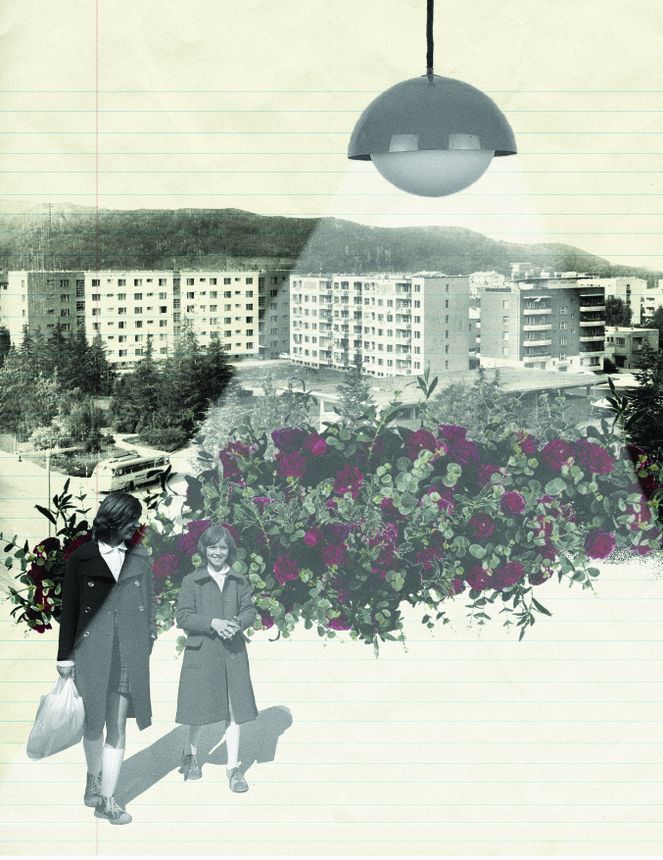
The Centre for the Development of Youth Culture—better known as CRMK—in Šempeter pri Gorici was one of the legendary alternative venues of the Gorizia region in the late period of the Socialist Federal Republic of Yugoslavia, comparable to Disco Študent and Club K4 in Ljubljana.
The idea for the club emerged in 1983 after the Rock Primorska event, which featured key figures of the Slovenian punk scene. What began as a programme focused on music and film gradually acquired a political dimension. The members of the club were also involved in the broader civil society, which at the time actively advocated for social and political change.
The club’s golden era came in the second half of the 1980s, when it was considered one of the central youth cultural hubs in Slovenia. The newly built shelter beneath today’s post office building was inaugurated on 25 May 1984 with a concert by the band Niet. Numerous cult Slovenian and Yugoslav bands performed at CRMK, including Borghesia, EKV, Partibrejkers, Disciplina kičme, Otroci socializma, KBO!, Gastrbajtrs, Tožibabe, CZD, Masaker, and Miladojka Youneed. Their activity was bold and influential enough to attract internationally recognised musicians such as The Ex, Eugene Chadbourne, and Disorder.
Interestingly, the authorities of the time appeared to tolerate alternative culture: in 1986, CRMK was awarded the highest federal recognition, the 25 May Plaque. This official acknowledgement improved relations with the local community, which became more accepting. At a time when most commercial dance venues were located in surrounding villages (Vipolže, Zeleni gaj near Dornberk, Miren, Prvačina, Šempas, Hum), CRMK also represented the only urban refuge for young people. Before the emergence of Mostovna, when Nova Gorica as a regional centre still lacked a space for alternative youth culture, CRMK effectively functioned as the city’s youth centre.
“I spent most of my free time there during my high school years. Over the summer, we began to give soul to the raw, expressionless concrete structure. We built a bar and a thirty-centimetre-high stage—there was simply no room for more. We lined the low ceiling of the concert hall with egg cartons to soften the reinforced concrete echo and improve the sound as much as possible. We painted the walls, installed projectors, and even a disco ball,” recalls one of the key figures, music journalist Igor Bašin.
Together with his brother Borut Bašin, Claudio Derlink Grattoni, Bojan Maraž, and others, they worked to ensure that something new happened in the space every week, or at least every month. When CRMK ceased operations in the mid-1990s due to generational changes and other factors, it left a significant void on the scene. Yet in its final years, it gave rise to the collective of young activists 13. brat, which later contributed to the creation of Mostovna. More about the history of this iconic club can be found in the documentary CRMK, bunker (2022) by director Bojan Maraž.
Avtor: Jaša Bužinel
Kraj: Šempeter pri Gorici